
Hey BlindsOnline.com Family,
If you own or manage rental properties, you already know that window blinds take a beating. Tenants pull them too hard, pets scratch at the slats, kids bend the vanes, and somehow every move-out reveals at least one set of blinds that looks like it survived a small disaster.
Choosing the right blinds upfront is one of those small decisions that saves you real money and real headaches over time. Here is what you need to know before your next purchase.
Why Rental Blinds Need a Different Standard
The blinds you would pick for your own home are not necessarily the right choice for a rental. At home, you control how the blinds are used. In a rental, you have much less say. That means durability, ease of cleaning, and low replacement costs matter far more than aesthetics.
Most states let a landlord deduct from the security deposit for damage beyond normal wear and tear, but what counts as normal varies by state, so check your local rules. Either way, proving damage and collecting on it takes time and creates friction.
The smarter play is choosing blinds that resist damage in the first place, so you spend less time in disputes and more time managing your portfolio.
The Three Types Worth Considering
Not all blinds hold up equally in a rental environment. Let’s compare the three most practical options.
Faux Wood Blinds
Faux wood blinds are one of the most popular choices for rental properties, and for good reason. They are made from PVC or a wood-polymer composite, which means they resist moisture, warping, and cracking far better than real wood. They look sharp, wipe down easily with a damp cloth, and hold their shape even in humid kitchens and bathrooms.
Durability is the main selling point. Individual slats can crack if a tenant is rough with them, but most faux wood blinds are built with enough rigidity to withstand daily use. They also tend to run at a reasonable price per unit, which matters when you are replacing blinds across multiple apartments.
The trade-off is weight: faux wood is heavier than aluminum, so on wide windows the lift mechanism and brackets matter more.
Aluminum Mini Blinds
Aluminum blinds are the budget-friendly workhorse of the rental world. They are lightweight, easy to clean, and inexpensive to replace. The downside is that they bend easily. One rough tug or a curious pet can crease a slat permanently, and bent aluminum blinds look cheap and worn even if they still function.
That said, aluminum blinds make sense in certain contexts, particularly lower-rent units where you need to keep costs minimal and expect higher turnover. They are inexpensive enough that replacing them every other tenant cycle can still pencil out.
Cordless Blinds
Cordless blinds deserve a spot on every landlord’s shortlist. They look clean, and with no dangling cords for tenants to yank, twist, or tangle, they remove one of the most common move-out problems.
They are also the safest option wherever young children may live. The CPSC recommends cordless window coverings for homes with young children, and the rules for new blinds have tightened:
-
Stock Blinds: Since December 2018, an industry safety standard has required stock (off-the-shelf) blinds to be cordless, to have inaccessible cords, or to have cords no longer than eight inches, a requirement the CPSC made mandatory for stock products in 2022.
-
Custom Blinds: Made-to-measure blinds followed with the updated ANSI/WCMA A100.1-2022 standard, which applies to blinds made on or after June 1, 2024, and eliminates free-hanging operating cords, free-hanging tilt cords, and multiple-cord connectors. While a federal rule for custom products was struck down by a court in 2023, making that update an industry standard rather than federal law—all major manufacturers follow it.
Two practical points follow: first, blinds already hanging in your units may predate these changes, so check for pull cords, loops, and free-hanging tilt cords during inspections, and replace those sets in units where small children might live. Second, corded versions are still sold online, so confirm that a product is described as cordless before you order.
Cordless blinds shift the strain to the lift mechanism, so look for models with solid internal hardware if you want them to last multiple tenant cycles. Very wide or tall windows can limit cordless options, so ask the supplier what is available at those sizes.
Common Damage You Will See at Move-Out
If you have been a landlord for any length of time, these scenarios will look familiar:
-
Bent or missing slats from being forced open or closed
-
Broken tilt rods from being twisted too aggressively
-
Cords tied in knots or frayed from repeated pulling
-
Slats discolored from cigarette smoke, grease, or pet contact
-
Entire blinds pulled off the mounting bracket
Most of this damage falls in the gray zone between normal wear and tenant negligence. The best way to sidestep the argument is to choose blinds that handle rough use without failing immediately. Thicker slats, robust brackets, and cordless mechanisms all reduce the frequency of these specific issues.
Photograph the blinds at move-in and again at move-out so both conditions are on record. Property managers such as Next Step PM post inspection reports to an online portal, so owners can see the condition at both points.
The Case for Standardizing Across Units
If you manage multiple units, standardizing blind sizes and styles is one of the most practical things you can do. When windows share a size, you can buy in bulk, keep spares on hand, and swap a damaged set in minutes instead of measuring every window on move-out or waiting on custom orders.
Standardizing the product does not standardize the windows, especially in older buildings. Keep a spec sheet for each unit listing every window’s size, mount type, and the blind installed, and stock spares only for sizes that repeat. A neutral color—white or off-white—hides wear and keeps any spare interchangeable.
Standardizing also makes documentation easier. If every unit has the same blinds installed at the same price, your move-out inspection forms are simpler and disputes are easier to resolve. Managers like CMC Realty & Property Management can use those unit specifications to handle inspections and replacements quickly and consistently.
Cleaning and Maintenance Between Tenants
Between tenants, blinds need a quick but thorough clean. Faux wood and aluminum blinds both wipe down well with a microfiber cloth and mild all-purpose cleaner. For heavier buildup, a bathtub soak works surprisingly well for aluminum. Faux wood should not be soaked, but handles a good wipe-down without issue.
Dust dry first, then wipe, and replace instead of cleaning when you see bent slats, smoke staining, or grease that will not come off. Choose blinds that are genuinely easy to clean rather than ones that trap debris in fabric folds or complicated mechanisms.
Fabric and cellular shades, while attractive, are much harder to clean and more expensive to replace. Save those for owner-occupied spaces where you have more control.
Practical Takeaways
Here is a quick summary to keep in mind when you are shopping:
-
Choose faux wood for bathrooms, kitchens, or any high-humidity space.
-
Use aluminum mini blinds only where budget is the primary concern and you expect frequent replacement.
-
Go cordless whenever possible: it is the safer choice, and it removes cord damage from your move-out list.
-
Standardize sizes and styles across your units, and keep a spec sheet for each one.
-
Stock spare sets for the sizes that repeat.
Rental property blinds do not have to be a constant source of frustration. Pick the right materials, keep it simple, and buy from a source that lets you order the same product again easily.
What Customers Are Saying…
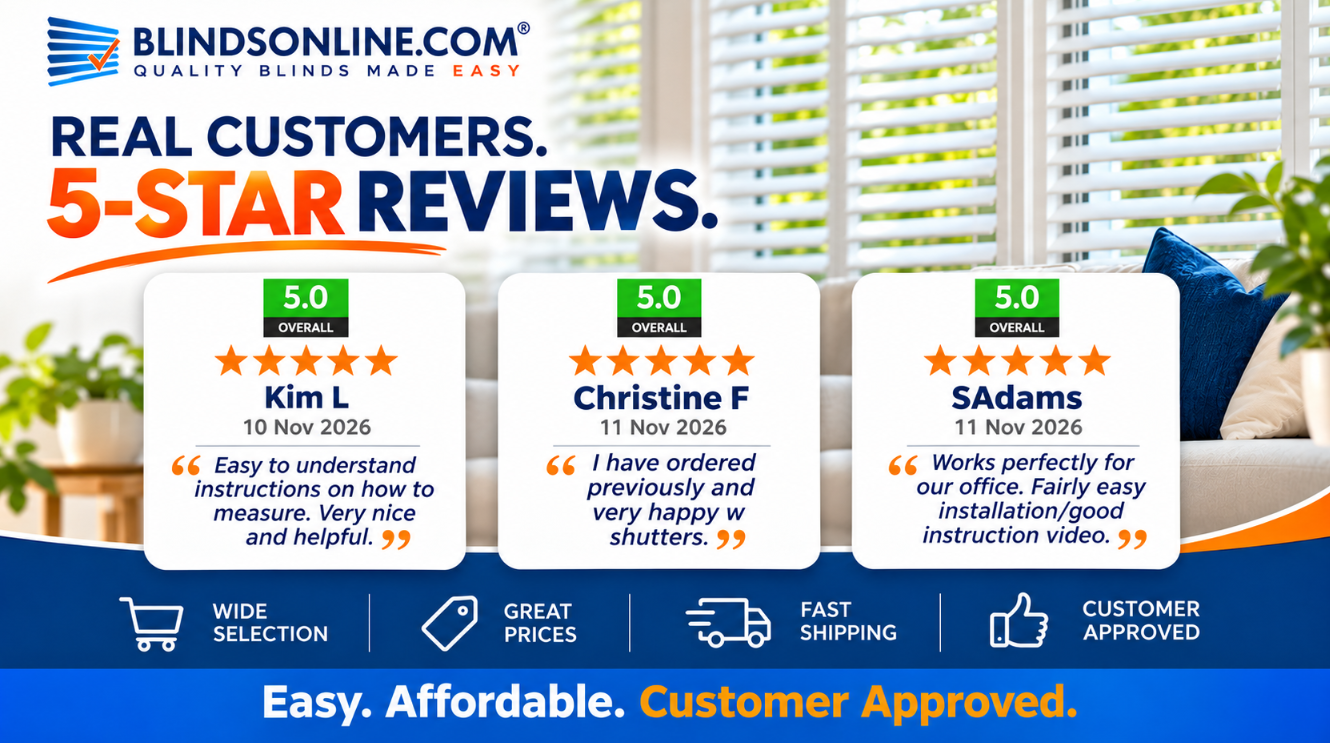
Ready to outfit your rental units without the move-out headaches?
Skip the flimsy big-box options and guesswork. Get durable, cordless-compliant faux wood and aluminum blinds that are easy to clean, simple to standardize across your properties, and easy to reorder whenever you need spares.
Coming Soon
New products and more colors are on the way, including exterior shades and motorization. You’ll hear about them here first.
Cheers,

Roger & Mike
The BlindsOnline.com Team
Questions about anything (shutters, shades, measuring, you name it)? Just hit reply or call us at 866-811-7727. A real human will pick up. Often one of us. 😄